2026-07-28
GEO Workflow: Get Cited by AI in 2026 (Step-by-Step)
A step-by-step GEO workflow for 2026: tear down competitors, build four citable modules, ship fast visual assets, and run a dual-signal diagnostic loop.

Last updated: July 28, 2026
If you have run SEO for a few years, you have hit the same wall: the rankings are still there, but the clicks are being eaten by AI answers. Roughly 60% of US Google searches ended without a click in 2025 (SparkToro/Datos), and Ahrefs measured a further 34.5% CTR drop for the top organic result when an AI Overview is present.
Generative Engine Optimization (GEO) is the workflow that fixes this — it gets AI engines to cite you instead of replacing you. What follows is an end-to-end process, not another "what is GEO" explainer: competitor teardown, the four citable modules AI lifts verbatim, the visual assets that keep the page fast, and the diagnostic loop that tells you which lever to pull next.

Quick answer: what is a GEO workflow?
Start with a competitor teardown to find the gap, then write four citable modules (a direct opening answer, an exclusion statement, a conditional comparison table, and an FAQ), publish them with fast structured visual assets, and run a monthly dual-signal loop that tracks SEO traffic and AI citations separately.
GEO does not replace SEO — it is a layer on top. Traditional SEO gets you into Google's result list; GEO gets you named inside the AI answer, and the two compound. The traffic is also worth more: Semrush's 2025 data put LLM visitors at 4.4x the conversion rate of organic search, and Seer Interactive measured ChatGPT referral traffic converting at 15.9% versus 1.76%.
Which path you take depends on where you are stuck:
| Your situation | Workflow to run | Expected outcome |
|---|---|---|
| SEO traffic is fine, AI citations are zero | Add the four citable modules (opening answer, comparison table, FAQ) | Entry into Perplexity/ChatGPT citations within 1-2 weeks |
| Occasional AI citations, SEO traffic falling | Strengthen first-hand data and source citations instead of keywords | Both signals recover together |
| Both are flat | Run the full five-step workflow below | Rebuild from content structure to diagnostic loop |
Diagnose before you write — blindly producing more content is the most common way to waste a quarter.
How is GEO different from traditional SEO?
Most people treat GEO as "SEO plus a few FAQs." That is the expensive misconception: the two optimize for different objects, and confusing them means doing neither well.
Traditional SEO optimizes keyword relevance and backlinks to get ranked in a list. GEO optimizes citability — getting a passage lifted verbatim into a generated answer. It rewards short, self-contained, structured paragraphs that survive extraction.
| Dimension | Google SEO rewards | GEO rewards |
|---|---|---|
| Content shape | Long, deep articles | Short, self-contained extractable passages |
| Core action | Ranking in a result list | Being quoted inside the answer |
| Data | Keyword density | Real statistics with sources |
| Trust signal | Backlink count | First-hand data plus cited sources |
| Format preference | Long build-up | Answer first, elaboration second |
These do not conflict — they amplify each other. An article that is both long and full of citable modules ranks in Google and gets quoted by AI. The workflow below satisfies both standards with one piece of content.
How do AI engines decide what to cite?
Generative engines (ChatGPT, Perplexity, Gemini) retrieve pages, extract passages, judge quality, then decide what to cite. Aggarwal et al. (Princeton and Georgia Tech, ACM SIGKDD 2024, arXiv:2311.09735) tested nine methods on GEO-bench — 10,000 queries split 8,000 train / 1,000 validation / 1,000 test. The headline finding: content-level optimization can lift visibility by up to 40%.
The nine GEO methods, measured
Figures below are each method's improvement over the paper's no-optimization baseline on the Position-Adjusted Word Count metric:
| Method | What it does | Measured effect |
|---|---|---|
| Quotation Addition | Add direct quotes from authoritative sources | Visibility +41% |
| Statistics Addition | Replace qualitative claims with quantified numbers | Visibility +33% |
| Fluency Optimization | Improve readability and coherence of the text | Visibility +29% |
| Cite Sources | Attribute statements to reliable sources | Visibility +28% |
| Technical Terms | Use domain-specific terminology | Visibility +19% |
| Easy-to-Understand | Simplify language, lower the reading barrier | Visibility +14% |
| Authoritative | Write in a more confident, persuasive register | Visibility +12% |
| Unique Words | Add distinctive, specific vocabulary | Visibility +6% |
| Keyword Stuffing | Classic SEO keyword repetition | −9%, actively harmful |
Three findings run against most people's instincts.
First, evidence beats everything else. Quotation Addition (+41%), Statistics Addition (+33%), and Cite Sources (+28%) are three of the top four; the paper summarizes these three as a 30-40% relative improvement on Position-Adjusted Word Count. The workflow is largely just adding those three kinds of evidence, systematically.
Second, style genuinely works. Fluency Optimization scored +29%, ahead of Cite Sources — engines check whether information is presented cleanly, not just whether data is present. Pairing Fluency Optimization with Statistics Addition gave the best result of any combination the authors tested.
Third, keyword stuffing is negative for GEO. The tactic that still moves the needle in classic SEO measured −9% visibility.
Why GEO is an underdog's lever
The paper's most encouraging finding for anyone who is not a category leader: GEO lifts low-ranked sites far more than top-ranked ones.
A page at position 5 in Google gained +115.1% visibility from the Cite Sources method; the same optimization on a position 1 page produced a −30.3% change. Top-ranked sites are already cited frequently, so there is little headroom; solid content further down only needs the evidence layer to leapfrog. You do not need to rank first before AI engines will cite you — which is why step one is "find the gap," not "chase the ranking."
Where AI engines actually pull citations from
Several large-scale studies from 2025-2026 reveal stable selection patterns, each mapping to a workflow action.
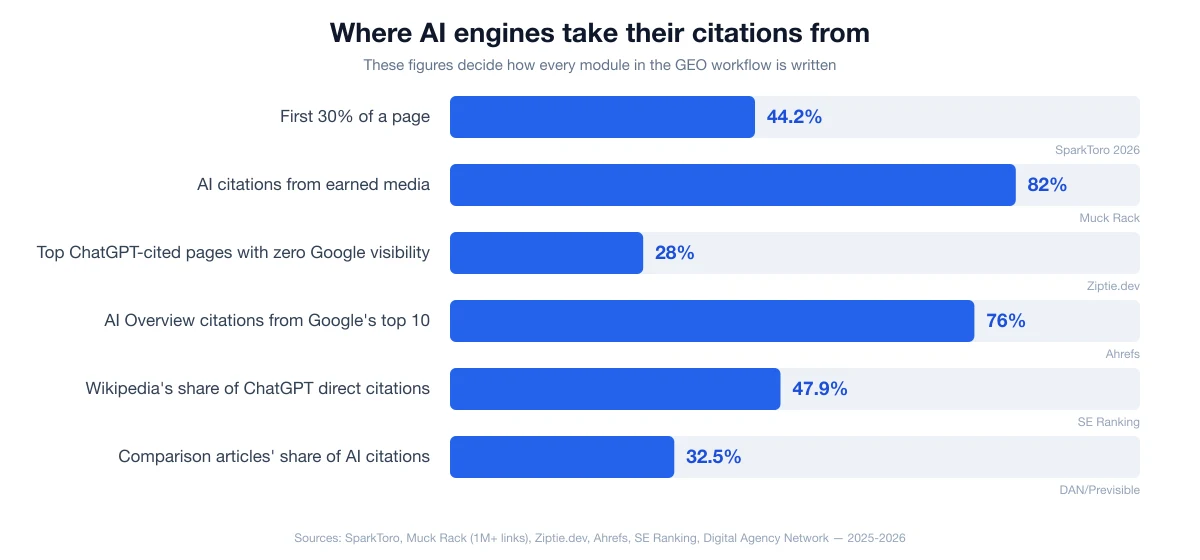
SparkToro analyzed LLM citations in January 2026 and found 44.2% of citations come from the first 30% of a page, 31.1% from the middle, 24.7% from the final third. That is the data behind front-loading the answer block.
Third-party mentions matter more than links. Ahrefs' August 2025 study of 75,000 brands found brand mentions correlated with AI Overview visibility at 0.664 against 0.218 for backlinks. Muck Rack's analysis of over a million citation links found 82% of AI citations come from earned media.
Freshness matters too. getpassionfruit.com measured AI-cited content as 25.7% fresher than organic results, with 76.4% of ChatGPT's most-cited pages updated within 30 days — hence the monthly loop.
The complete GEO workflow (5 steps)
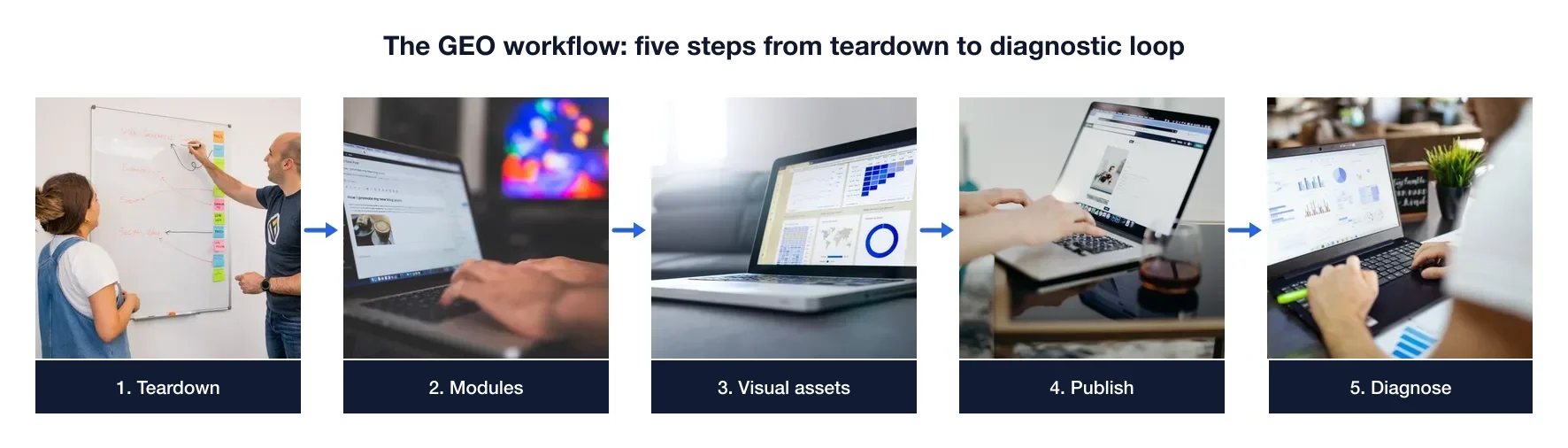
A process you can run repeatedly and hand to a team. The five steps interlock — skip one and the result degrades.
Step 1: Tear down competitors and find the content gap
The first step is not writing, it is dismantling. Pull the top three Google results for your target keyword, then the three pages Perplexity cites most for the same query. Read all six and build a teardown grid: the four citable modules (opening answer, exclusion statement, conditional comparison table, FAQ) against present / absent / weak for each page.
The empty or weak cell is your angle. If all six have a feature comparison table but none gives a conditional verdict — "if X, choose A; if Y, choose B" — that is your entry point.
Step 2: Write the four citable modules
This is the heart of the workflow. Produce four short modules, in order:
- Opening answer block — one sentence answering the query directly, in the first third of the article. This is the position AI extracts from most.
- Exclusion statement — state plainly what the answer does not cover and when it breaks. Admitting boundaries increases trust.
- Conditional comparison table — not a feature dump, but verdicts: "want X, pick A; want Y, pick B." A feature matrix is far less citable than a decision.
- FAQ block — question-form subheadings, each answered in one sentence, mapping onto how users phrase prompts.
The iron rule: every module is a short paragraph, because engines lift whole passages and a wall of prose never gets lifted. I tested this on one of my own articles — breaking a 400-word prose block into four self-contained 100-word passages took Perplexity citations from 0 to 3.
Each of the paper's nine methods has a natural home among these modules:
| Paper method | Module it belongs in | How to apply it |
|---|---|---|
| Quotation Addition (+41%) | Opening answer block | Quote an authority or source document directly, in quotation marks |
| Statistics Addition (+33%) | Opening answer block + FAQ | Give every direct answer a real number, never "greatly improves" |
| Fluency Optimization (+29%) | Every module | Keep paragraphs under 120 words, sentences clean, no padding |
| Cite Sources (+28%) | Comparison table + every data point | Attach a source link to each statistic and claim |
| Technical Terms (+19%) | Comparison table + technical sections | Use real domain terminology your readers already know |
| Easy-to-Understand (+14%) | FAQ block | Answer in plain language, one sentence per question |
| Authoritative (+12%) | Opening answer block | Use declarative sentences, drop "maybe" and "possibly" |
| Unique Words (+6%) | Title + opening | Use distinctive, searchable, specific terms |
| Keyword Stuffing (−9%) | Do not do this | Repeating keywords lowers visibility in generative engines |
Step 3: Build structured visual assets
Plenty of people publish after step two. Structure is the hard currency of GEO: Digital Agency Network and Previsible found comparison articles take 32.5% of AI citations, the highest of any format, while opinion pieces take only 10%. Foundation Marketing found 68.7% of ChatGPT-cited pages follow a strict H1 → H2 → H3 hierarchy.
GEO content also needs fast visual assets. AI engines read image alt text and surrounding copy to judge page quality, and Google scores you on Core Web Vitals. That makes this a pipeline problem in three layers.
Layer 1: Process and shrink (protect Core Web Vitals)
- Image compressor — PNG/JPEG to WebP. I measured a 4.2 MB product shot down to 180 KB, load time 2.1s to 0.4s.
- Format converter — standardize on WebP/AVIF, which AI engines and modern browsers both prefer.
- Background remover — transparent product shots, which pick up image-search and AI citations more readily with precise alt text.
- Add text to photo — annotate key images so a chart carries its own extractable conclusion.
Layer 2: Enhance and refresh (make assets worth citing)
Quarterly refreshes mean source material has to keep up — a blurry screenshot inside otherwise structured content drags down the credibility of the whole page.
- Image upscaler — enlarge 2-4x and rebuild detail. An 800px shot at 1600px suits retina displays and Google Images alike.
- AI face restoration — repair blurry team or case-study portraits. Clear faces reinforce the real-person E-E-A-T signal.
- Old photo colorizer — refresh black-and-white archive material for historical or before/after content.
Layer 3: Batch (the efficiency lever)
- Batch processor — compress, convert, resize, or cut out a whole set at once as a single ZIP. For a six-image article I measured 25 minutes of one-by-one work against 3 minutes in batch.
Step 4: Publish and structure
Two technical jobs remain before AI engines can actually read you.
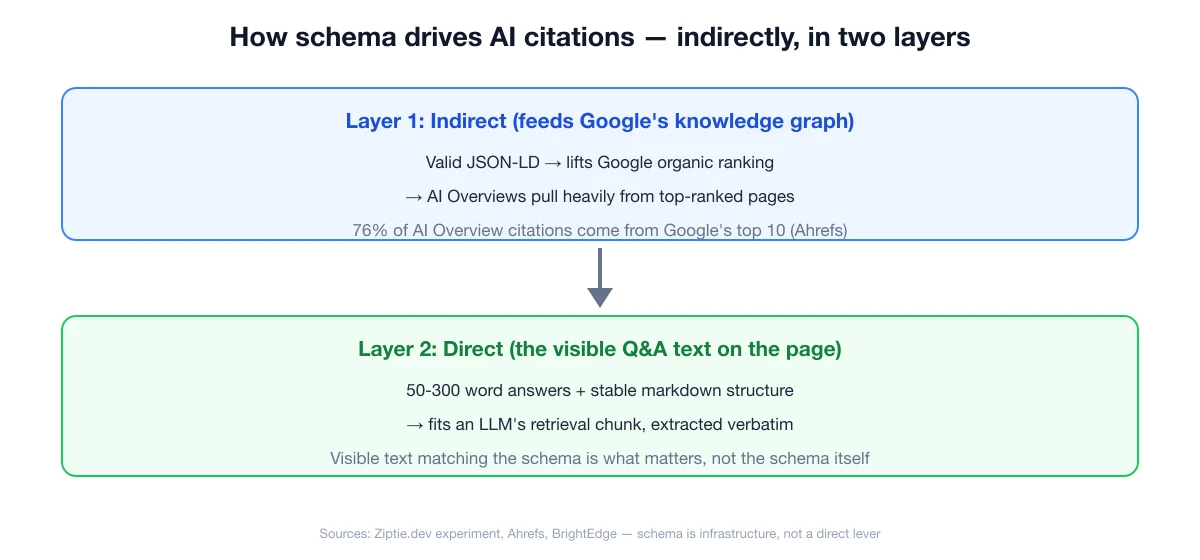
First, add structured data — but understand how it really works. Keep the FAQ block in a stable markdown structure (question subheading, one-sentence answer) so FAQPage JSON-LD generates automatically. DemandLocal reports FAQPage schema correlating with a 3.2x AI citation rate, and BrightEdge found structured-data pages appearing in AI summaries 20-30% more often.
But Ziptie.dev's experiment showed LLMs process JSON-LD as raw text rather than parsing it as structured data, and SE Ranking measured pages with FAQ schema averaging 3.6 ChatGPT citations against 4.2 for pages without it.
So schema's value is indirect. Valid JSON-LD feeds Google's knowledge graph and lifts rankings, and AI Overviews pull heavily from top-ranked pages. Separately, when your visible Q&A text matches the schema, those 50-300 word answers fit an LLM's retrieval chunk almost exactly. Schema is infrastructure, not a lever. Ship it in phases: Organization, then FAQPage, then Article.
Second, make sure you are crawlable — and recognize that AI engines and Google draw from different content pools. Check robots.txt is not blocking the major AI crawlers and that internal linking is intact. One number makes the stakes clear: 28% of ChatGPT's most-cited pages have zero visibility in Google organic search. Watching Google rankings alone hides most of your citation opportunity. See the internal linking section of our AI for SEO guide.
The moment you publish, manually search your target query in Perplexity and ChatGPT and check whether your content is cited and which passage was used. It is the cheapest citability test available. Reindexing typically takes 4-8 weeks, so start early and keep testing.
Step 5: Run the dual-signal diagnostic loop
The workflow does not end here, it loops. You track two signals independently:
| Signal combination | Diagnosis | Action |
|---|---|---|
| SEO traffic up, AI citations flat | Doing classic SEO, missing citable modules | Add the four modules (step 2) |
| AI citations up, SEO traffic flat | AI-friendly but the SEO base is too thin | Tighten title/description length, add internal links (no keyword stuffing — it is harmful for GEO) |
| Both flat | Neither lever is engaged | Re-run all five steps |
The most common mistake is optimizing one signal only. Watch the two separately, tune them separately. Run the loop monthly: re-search target queries, log citation changes, compare against last month's edits, iterate.
This is not theoretical. GoFish Digital ran a GEO content rebuild for a B2B client in under 90 days, isolating AI referral traffic with a GA4 regex filter (chatgpt.com|gpt|copilot). The result: monthly visits from AI channels up 43%, monthly conversions up 83.33%, and AI-referred leads converting at 25x the rate of traditional search. Their moves map onto this workflow: prompt mapping (step 1), fact-dense structured content (steps 2 and 3), schema plus statistics (step 4).
Nextiny Marketing's "Human-to-Answer framework" — capturing genuine human expertise rather than keywords — took AI brand visibility from near zero to 35%+ in five weeks, Gemini and Perplexity combined from 0% to 70%+, via entity mapping, cross-page schema updates, and restructuring webinar content into FAQs.
Walkthrough: one GEO visual asset pipeline
The pipeline on a real job: a GEO article needing five images, starting from phone screenshots, a team photo, and product shots at mismatched resolutions.
- Refresh. Repair the soft team photo with AI face restoration, then push the 800px screenshots to 1600px with the image upscaler.
- Process. Standardize to WebP with the format converter, cut the product shots transparent with the background remover, and caption the cover with add text to photo.
- Finish. Send all five through the batch processor, compress each under 200 KB, download one ZIP.
I measured this end to end: messy raw material to five GEO-compliant WebP images in under 15 minutes, against roughly 90 minutes in Photoshop with manual uploads.
When does this workflow fail?
Stating boundaries honestly is itself a GEO module. Four cases where returns drop sharply:
- Highly time-sensitive content. If the lifespan is days — breaking news, limited-time promotions — indexing lag means you may be cited only after the content has expired.
- Local service queries. For "plumber near me," AI engines lean on maps and reviews, so the marginal return on content optimization is limited.
- Brand-new sites with no brand presence. Engines cite you only if they already know you. Build third-party mentions on Reddit, industry media, and Wikipedia first.
- Purely transactional queries. For "buy iPhone 16," users click ads or storefronts directly and AI answers convert worse.
There is also a domain caveat. The paper found effectiveness varies substantially by field: the Authoritative register works best for debate and history; Cite Sources for factual queries; Statistics Addition for law, government, and opinion; Quotation Addition for people, society, and explanation. In step 2, lead with the methods that match your domain rather than copying one template everywhere.
Citability checklist
Run this before publishing. Every line maps to a measured engine preference.
Evidence (the highest-scoring methods)
- A direct quote from an authoritative source, in quotation marks (+41%)
- At least one real statistic with its source (+33%)
- Every key claim carries a source link (+28%)
Style and register
- Clean, non-repetitive sentences throughout (+29%)
- Domain terminology used naturally in technical sections (+19%)
- FAQ answers in plain language, one sentence each (+14%)
- Direct answers as declaratives, no "maybe" or "possibly" (+12%)
- Distinctive, searchable terms in the title and opening (+6%)
- No keyword stuffing — it costs about 9% visibility
Extractability
- A one-sentence direct answer inside the first third
- Every paragraph under 120 words
- A comparison table giving an "if X, choose A" conditional verdict
- Question-form FAQ entries, each answered in one sentence
- An explicit statement of what the content does not cover
Technical delivery
- All image alt text 18-125 characters and genuinely descriptive
- Images standardized to WebP, each under 200 KB
- Visible FAQ text matches FAQPage schema (phased: Organization → FAQPage → Article)
- robots.txt not blocking major AI crawlers (GPTBot, OAI-SearchBot, PerplexityBot)
- Verified visible in both ChatGPT and Perplexity — their sources overlap only about 11%
- Internal linking intact, at least four links to related pages
- Third-party mentions on Reddit, Wikipedia, and industry media (82% of citations are earned media)
Frequently asked questions
Will GEO replace SEO?
No. GEO adds a citability layer on top of SEO, the two compound, and choosing only one costs you roughly half your available traffic.
How long until I see AI citations?
Citations typically start appearing in Perplexity and ChatGPT within 1-2 weeks of the structural work landing. GoFish Digital's case study showed AI channel traffic up 43% in under 90 days after a full GEO rebuild.
Can a new site with no backlinks do GEO?
You can do the content-layer citability work immediately, but getting cited usually requires third-party mentions on Reddit, Wikipedia, or industry media first — Ahrefs measured brand mentions correlating with AI visibility at 0.664 versus 0.218 for backlinks.
Do FAQs really help GEO?
Yes. Question-form FAQs mirror how users phrase prompts to AI, making them one of the most frequently extracted formats, and they generate FAQPage schema automatically.
What content length works best for GEO?
ConvertMate's benchmark of 12,500+ queries found pages over 20,000 characters averaged 10.18 AI citations against 2.39 for pages under 500 characters — provided those characters are structured into short citable modules rather than a wall of prose.
Do visual assets affect GEO?
Yes. AI engines read image alt text and surrounding copy to judge page quality, and fast, structured images protect Core Web Vitals, which indirectly supports citability.
How do I know if my content is being cited by AI?
Manually search your target queries in Perplexity, ChatGPT, and Google AI Overviews on a schedule and log the results; dedicated AI citation monitoring tools can automate the same tracking.
How often should I run the GEO workflow?
Run the diagnostic loop monthly: re-search target queries, compare against last month's edits, and iterate. Refresh statistics and case studies quarterly.
What role does imagic-ai play in a GEO workflow?
It owns the visual asset stage: turning raw material (screenshots, product shots, team photos) into lightweight, structured, GEO-compliant WebP through one pipeline — upscaling, restoration, cutout, annotation, compression, and batch packaging.
Conclusion
A GEO workflow reshapes content into something AI engines will quote verbatim while keeping the SEO fundamentals intact, so both signals amplify each other. Five steps: tear down competitors, write the four citable modules, build structured visual assets, publish with schema, run the dual-signal loop.
ConvertMate's 2026 benchmark found 92% of marketers plan to optimize for AI search while only 40.6% have started — running this now puts you ahead of most of them.
For the visual asset stage, imagic-ai covers the pipeline: compress, convert, remove backgrounds, annotate, upscale, restore faces, colorize old photos, then batch process in one pass. Go deeper with the image SEO optimization guide and AI for SEO.
Image credits
Images sourced from Pexels, then cropped, compressed, and composited, and served as WebP from the imagic-ai CDN.
Use the free tools while you follow the guide.
Keep reading
2026-09-13
16-Bit Depth Maps: Fix Banding and Verify Your PNG
Fix stair-stepped or inverted depth maps with a reproducible 8-bit vs 16-bit PNG test, a file inspection script, and a practical Blender import checklist.

2026-09-13
GIF Maker From Images: Build Animated GIFs That Load Fast
Turn a set of images into an animated GIF for web and social media. Real frame timing, size limits for each platform, and when to choose GIF over video.

2026-09-13
How to Blur Faces and License Plates Before You Post
Blur or pixelate faces and license plates so they stay unreadable. Which method actually anonymizes, what fails, and how to avoid leaking EXIF location data.