2026-03-28 · Updated 2026-07-26
How to Compress an Image to Under 50KB (Thumbnails and Avatars)
Get a photo under 50KB for thumbnails, avatars, and small icons by resizing to display size and encoding WebP, with measured file sizes and working commands.

Last updated: July 26, 2026
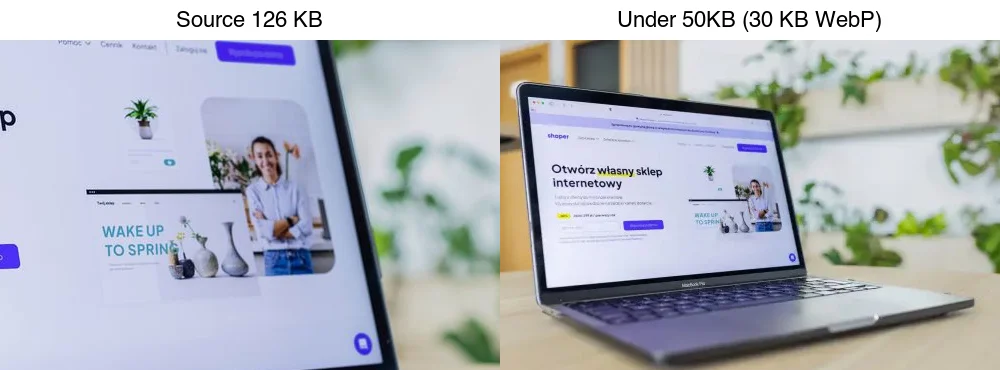
50KB is a tight target, but for thumbnails, avatars, and small icons it is more than enough to look sharp — if you resize first. The mistake that blocks most people is compressing a large photo without resizing it; at 50KB you cannot skip the resize step. This guide shows the reliable path with the real file sizes I measured on one 126 KB source photograph.
Quick answer: how do you compress an image to under 50KB?
Resize the image down to the small display size it will actually be shown at (typically 200–600px for a thumbnail or avatar), then encode it as WebP. On the test photo, resizing to 600px and encoding WebP q70 produced a 15 KB file — well under 50KB, with no visible quality loss at that display size.
| Method | Result on a 126 KB source | Use when |
|---|---|---|
| JPEG, quality only | Will not reach 50KB cleanly | Avoid for this target |
| Resize to 600px + JPEG q70 | 25 KB | Simple, broad compatibility |
| Resize to 600px + WebP q70 | 15 KB | Web pages, best result |
| Resize to 200px + WebP | ~5 KB | Tiny avatars / list icons |
For the format reasoning behind these numbers, see the AVIF vs WebP vs JPEG comparison.
Why resizing is mandatory at 50KB
At a 50KB target, quality-only compression fails. A 1600px photo squeezed into 50KB of JPEG looks blocky because the encoder has to throw away too much per pixel. But that same photo shown at 600px has roughly 7× fewer pixels — so each pixel keeps far more quality budget.
The size drop is almost entirely from the resize, not from the format switch:
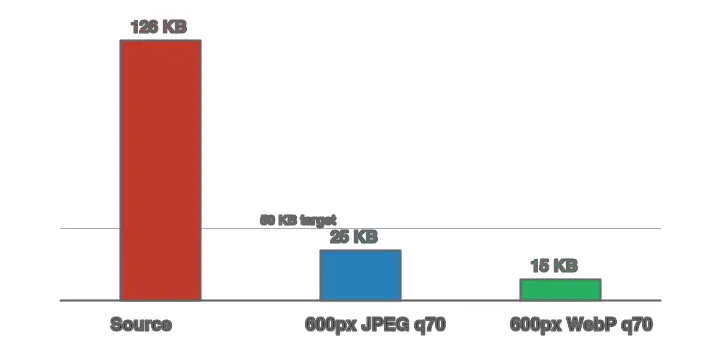
Pick the resize width by where the image is shown. An avatar displayed at 96×96 does not need a 600px source; a product list thumbnail shown at 300px wide does. Match the pixels to the display, as the batch resize guide recommends.
What resize width matches each use case?
The right width depends on where the image is shown. These are the dimensions that comfortably fit under 50KB after WebP encoding on a typical photograph:
| Use case | Display size | Source width to export | Typical WebP size |
|---|---|---|---|
| Forum / chat avatar | 64–128px | 200px | 3–6 KB |
| Profile photo | 200–400px | 400px | 8–14 KB |
| Product list thumbnail | 200–300px | 600px | 12–18 KB |
| Small article inline image | 400–600px | 600–800px | 15–30 KB |
| Email header image | 600px | 600px | 20–35 KB |
Export at roughly 1.5–2× the display width to stay sharp on high-DPI screens, but not so large that you waste bytes. A 2× rule for a 96px avatar is 192px — not 1200px.
How does 50KB fit into Core Web Vitals?
Tiny thumbnails are rarely the LCP element, so hitting 50KB on them is more about total page weight and scroll smoothness than about LCP directly. Where it matters is page weight on mobile: a product listing with 40 thumbnails at 150KB each is 6 MB of images to download over a cellular connection before the page finishes loading. The same listing at 15KB each is 600 KB — a 10× reduction that speeds up every page on the site. Compressing thumbnails is high-leverage because there are many of them. Google's images and Core Web Vitals guidance covers the LCP side; the thumbnail side is pure byte budgeting.
Method 1: Browser compressor
For one image, use the Imagic AI Image Compressor: upload, resize to the display width (200–600px), pick WebP, set quality around 70, and download once the reported size is under 50KB. For exact visual control, Squoosh shows the output size live as you move the sliders.
Method 2: WebP on the command line
WebP reaches the 50KB target at higher quality than JPEG, so it is the right default for web thumbnails.
## Resize to 600px wide, encode WebP at quality 70
cwebp -q 70 -resize 600 0 input.jpg -o thumb.webp
For a folder of thumbnails:
mkdir -p out
for f in *.jpg; do cwebp -q 70 -resize 600 0 "$f" -o "out/${f%.jpg}.webp"; done
Method 3: Python with a size guarantee
When the 50KB cap is enforced by an upload system, loop quality down until the file fits, resizing first:
from PIL import Image
from pathlib import Path

def to_under_50kb(src: Path, dest: Path, width: int = 600):
    with Image.open(src) as img:
        if img.width > width:
            ratio = width / img.width
            img = img.resize((width, int(img.height * ratio)), Image.LANCZOS)
        quality = 80
        while quality >= 20:
            img.save(dest, "WebP", quality=quality)
            if dest.stat().st_size <= 50 * 1024:
                return dest.stat().st_size / 1024
            quality -= 5
    return dest.stat().st_size / 1024

print(to_under_50kb(Path("photo.jpg"), Path("thumb.webp")))
Which method should you pick?
| Situation | Method |
|---|---|
| One avatar or thumbnail | Browser compressor or Squoosh |
| Web thumbnails, smallest bytes | Resize + WebP CLI |
| Strict 50KB upload cap | Python target loop |
| Recurring batch | cwebp in a shell loop |
Common mistakes
- Compressing without resizing. At 50KB this guarantees ugly output. Resize first.
- Using too large a resize width. A 1200px thumbnail shown at 200px wastes bytes. Match the display size.
- Keeping EXIF metadata. Strip it for web thumbnails; metadata is a meaningful fraction of a 50KB file.
- Re-encoding an already-tiny JPEG. Each pass adds artifacts. Work from a master.
Final pre-export checklist
- Start with the smallest acceptable pixel dimensions.
- Use WebP before trying extreme JPEG quality settings.
- Avoid 50KB for full-width hero photos.
- Strip metadata and thumbnails from the export.
- Check text, faces, and product edges at 100%.
Frequently asked questions
Can a photo look good at under 50KB?
Yes — at the small display sizes thumbnails and avatars actually use (under ~600px). It will not look good at full-screen size, because there is not enough data. Match the pixels to the display.
JPEG or WebP for a 50KB target?
WebP. It reaches the target at higher quality. Keep a JPEG in a <picture> fallback for very old clients.
What size should I resize to?
The display size. An avatar at 96px needs ~96–200px source; a list thumbnail at 300px needs ~300–600px. See the image compression deep dive for the resize-before-compress reasoning.
How do I compress an image to under 50KB?
Resize to a small width first (mandatory at 50KB), then convert to WebP and compress at quality 75–80. At 50KB you are in thumbnail and avatar territory — a content photo will not fit cleanly. Match the resize width to the tiny use case: roughly 300–600px for a thumbnail or avatar.
Where is a 50KB image used?
Avatars, thumbnails, icons, and tiny web graphics — anything displayed small. A 50KB image is not suitable for a hero or a content photo; those need more pixels and bytes. Match the budget to the display size: small display, small file; large display, larger file.
Should I use WebP or JPEG at 50KB?
WebP. It is 25 to 35 percent smaller than JPEG at equal quality, so a WebP file hits 50KB at higher quality and sharper detail. Serve it with a JPEG fallback through a <picture> element so older browsers still get a working image.
What resize width matches 50KB?
Roughly 300–600px for a thumbnail or avatar at WebP quality 75. A larger image will not fit in 50KB without heavy artifacting. Pick the width by where the image is displayed, and the 50KB target becomes reachable cleanly.
Is 50KB small enough for Core Web Vitals?
Yes — a 50KB image loads near-instantly and keeps LCP healthy, which is why it suits thumbnails and avatars that appear above the fold. The trade-off is dimension: at 50KB you are in small-image territory, not content photography. Match the budget to the display size and the format (WebP) to hit it cleanly.
Can a photo fit under 50KB?
Only at small dimensions. A content photo (1200px+) will not fit under 50KB without heavy artifacting and banding in gradients. 50KB suits avatars, thumbnails, and tiny web graphics. For content photos, target 200KB or accept a larger file. Match the byte budget to the display size — small display, small file.
Does resizing or compressing save more bytes?
Resizing, by a wide margin. Removing pixels cuts the data the encoder stores; lowering quality only squeezes each remaining pixel harder. At the 50KB target especially, you must resize to a small width first, because no quality setting fits a large image into 50KB without heavy artifacting.
Image credits
- Compression-path comparison, before/after, and size chart — generated by the author from an ecommerce-style photograph (Pexels #16675632, photo by Mikael Blomkvist) to show real measured file sizes for a 50KB target.
Use the free tools while you follow the guide.
Keep reading
2026-09-10
Image Blurry After Export? 7 Fixes That Target the Cause
Fix an image blurry after export by checking pixels, compression and upload changes. See measured examples, PNG vs JPEG choices, and seven practical fixes.
2026-08-01
Image Compression in 2026: WebP, AVIF, JPEG XL & JPEG AI Benchmarked
I benchmarked WebP, AVIF, and JPEG XL on 4 real photos. WebP saves 32% vs JPEG, AVIF 65%, JPEG XL 30%. Full data, browser support, and which format to pick in 2026.
2026-07-26
Image Optimization Checklist: Every Step for Fast Web Images
A complete image optimization checklist: format choice, resizing, compression, responsive delivery, lazy loading, and CDN setup. Run through it before every publish.