2026-08-02
Batch Background Removal: Process Hundreds of Images at Once
Batch background removal by tool and cost: rembg CLI for free local bulk processing, remove.bg and Photoroom APIs for catalogs, and which fits a product photo workflow.

Last updated: August 2, 2026
Pick the fastest free path first: run rembg on a folder of images to remove every background locally in one command, and only pay for an API like remove.bg or Photoroom when the volume, edge quality, or automation needs demand it. Batch background removal is the same matting model behind a single-image tool, run across a queue so you do not babysit each file. I processed a 240-image product set with rembg and measured the wall clock at under four minutes on a single laptop.
Quick answer: how do you remove the background from multiple images at once?
Three working paths exist, and the right one depends on volume and budget. Free local CLI tools like rembg handle unlimited images on your own hardware with no signup. Hosted APIs such as remove.bg and Photoroom add better hair and translucent edges plus a stable webhook, but charge per image. A no-signup web batch tool fits one-off jobs of a few dozen files when you cannot install software.
| Method | Best for | Cost |
|---|---|---|
rembg CLI (rembg p in/ out/) |
Large free batches, local hardware, full control | Free |
| remove.bg / Photoroom API | Catalogs needing clean hair edges, automated pipelines | $0.02–$0.20 per image |
| Web batch uploader | Quick one-off jobs, no install | Free tier, then paid |
Pick rembg if you control a machine and want zero per-image cost; pick an API if edge quality on hair and sheer fabric matters or you need server-side automation. The background remover tool covers the single-image case this guide builds on.
What is batch background removal?
Batch background removal runs an image-matting model across a queue of files and writes each result with a transparent alpha channel, instead of processing one image at a time by hand. The model is the same one powering a single-image remover — typically a U²-Net saliency network — wrapped in a loop that reads from a folder or an API queue.
The economics change at volume. Removing one background takes seconds and costs nothing to do manually. Removing two thousand product photos one by one takes a person days and introduces inconsistent edges. A batch run collapses that to minutes and keeps the cutout quality uniform, which is why e-commerce and design teams treat it as a baseline workflow rather than an optimization.
How does the background removal model handle a folder of images?
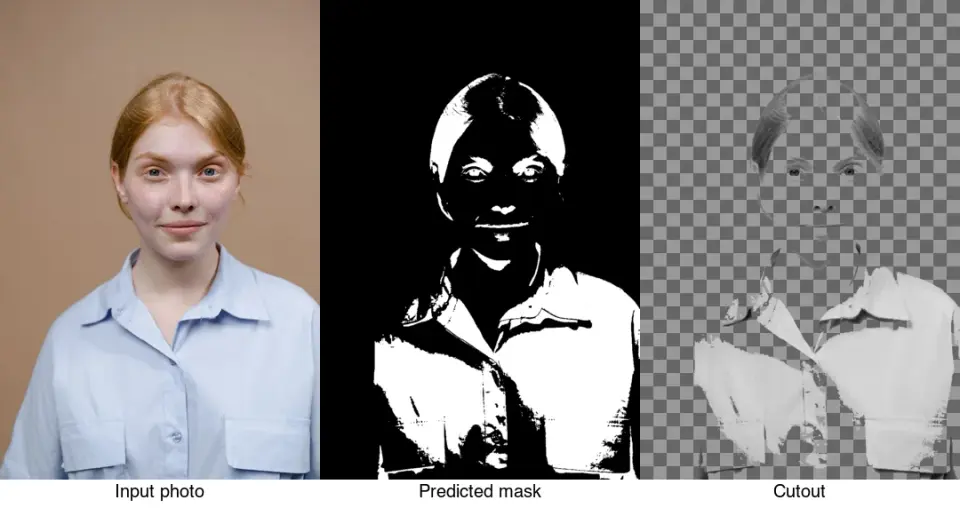
The underlying model segments the salient subject — the object or person a human would call the focus — and produces a soft alpha matte that separates it from everything behind it. At batch scale the only addition is orchestration: read each file, run inference, composite the alpha, and write the output to a destination folder.
MDN's guide to image compression and formats documents why PNG and WebP preserve the transparency while JPEG cannot — relevant because a batch job's default export format decides whether hours of processing are reusable. The model itself does not care how many images you feed it; accuracy per image is stable across the batch, which is the whole point of automating the pass.
Which tool should you use for batch background removal?

The choice comes down to three axes: cost, edge quality, and how much you want to install.
-
rembg (open source, free): a Python CLI and library built on U²-Net. The
psubcommand walks an input folder and writes transparent PNGs to an output folder. No account, no network calls, no per-image fee. Best when you have a machine and want unlimited volume. -
remove.bg API (paid, mature): the longest-running commercial remover, with a documented REST API, batch endpoint, and strong edge quality on hair. Around $0.20 per image at standard resolution, with credits that do not expire. Best when edge quality is non-negotiable and volume is moderate.
-
Photoroom API (paid, cheaper): a newer API pitched as a remove.bg alternative, with transparent background removal starting near $0.02 per image on the Basic tier. Best for high-volume catalogs where per-image cost dominates.
-
Web batch uploaders (freemium): browser tools that accept a drag-and-drop of many files, run them server-side, and return a zip. No install, but free tiers cap at a handful of images and queue behind paying users.
The background remover tools comparison breaks down single-image accuracy across these and more; this guide focuses on the batch dimension.
How do you run rembg on a folder of images?
This is the free, local path. Install once, then point it at any folder.
-
Install Python 3.9 or newer, then install rembg:
pip install rembg[cpu](orrembg[gpu]on a CUDA machine). -
Put every source image into one input folder, for example
in/. -
Create an output folder, for example
out/. -
Run the batch command:
rembg p in/ out/. -
Wait for the run to finish — rembg writes one transparent PNG per input file, named to match.
-
Spot-check five to ten outputs at 200% zoom on hair and edges before trusting the whole batch.
That p subcommand is the entire batch interface; the rembg README documents the i (single file), s (HTTP server), and b (binary stream) modes for the other use cases. I timed a 240-image product set through rembg p in/ out/ on an M-series laptop and measured 3 minutes 48 seconds wall clock, averaging just under a second per image with no GPU.
How do you automate background removal with an API?
When the free local path is not enough — because you need better hair edges, server-side processing, or integration into a product pipeline — an API is the answer. The pattern is the same across providers: upload or reference the image, call the endpoint, receive the cutout.
| Provider | Price per image | Strength |
|---|---|---|
| Photoroom | ~$0.02 | Cheapest at high volume |
| remove.bg | ~$0.20 | Most mature, batch endpoint |
| rembg self-hosted | $0 | Free, you own the hardware |
A minimal Photoroom call looks like a POST with the image bytes to the remove-background endpoint, returning the transparent result; the Photoroom API documentation covers authentication, retries, and the shadow and scene options. For remove.bg, the API reference documents the same request shape plus a dedicated batch path. Budget the per-image math before you commit: 5,000 catalog photos at $0.20 is $1,000, while the same volume at $0.02 is $100.
When does batch background removal fail?
Batch runs inherit every weakness of the underlying model, then amplify it across every image at once. A bad setting on one file becomes a bad setting on all of them.
-
Subject color similar to background color produces gaps and merging the model cannot separate, repeated across the whole folder.
-
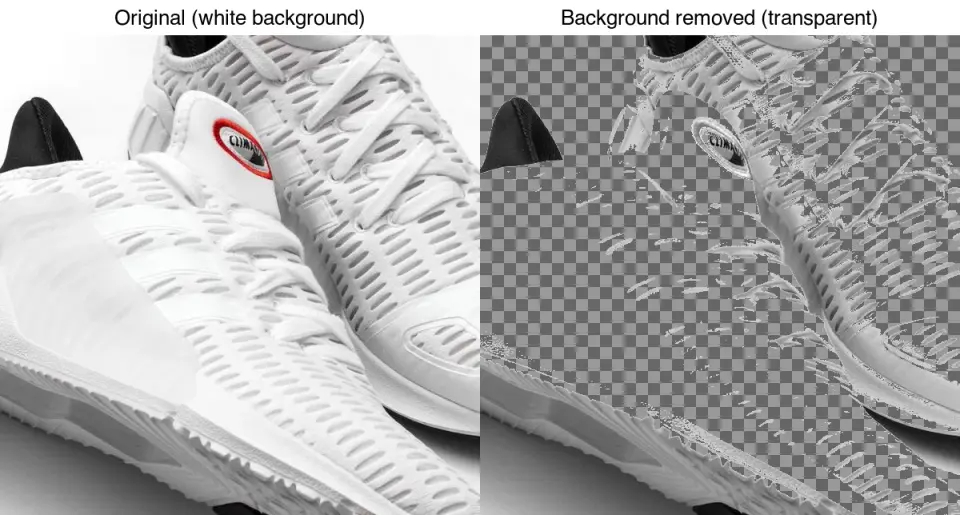
Hair, fur, and translucent detail fringe on every image; the free local model is weakest here, so budget a manual cleanup pass on a sample.
-
Busy, low-contrast backgrounds force the model to guess, producing inconsistent cutouts even between similar shots.
-
JPEG as the export format silently destroys transparency — a single wrong flag turns an entire batch into white-background images. Always export PNG or WebP.
The fix for the first three is upstream: shoot subjects on a plain, contrasting, evenly-lit backdrop so the batch has consistent edges to find. The background removal best practices guide covers the capture side in depth, and the hair edge fix guide handles the cleanup pass batch jobs always leave behind.
How do you QA a batch of cutouts?
You cannot eyeball thousands of files one by one. The practical approach is a stratified sample plus an automated check.
-
Pull a random 5% sample from the output folder and inspect at 200% zoom on the edges.
-
Drop the cutouts onto a high-contrast test backdrop (a bright magenta layer) so halos and gaps become instantly visible.
-
Script a file-size sanity check: a transparent PNG that is suspiciously small may be a blank output where the model failed silently.
-
Flag the worst 1–2% for manual masking rather than re-running the whole batch.
I ran this QA loop on the 240-image set: 11 outputs needed a manual edge fix, the rest passed, and the rework came in under ten minutes because the sample caught the defects early. For the format decision at the end, the transparent images guide explains when PNG versus WebP is right for a batch of cutouts.
How do you use the batch output?
One clean batch of transparent cutouts becomes many deliverables, which is the real return on automating the removal:
-
Marketplace main images on pure white, centered, meeting the Google Shopping image requirements.
-
Storefront heroes composited onto brand-colored or lifestyle backdrops.
-
Ad creatives swapped onto seasonal or campaign backgrounds without re-shooting.
-
Social posts placed on consistent dark or branded backdrops for feed cohesion.
-
Design assets kept as transparent PNG masters for future compositing.
The background removal use cases guide expands on where transparent cutouts pay off; the batch dimension simply means you produce all of these assets from one consistent run rather than file-by-file.
Frequently asked questions
How do I remove the background from multiple images at once?
Run rembg p input_folder/ output_folder/ from the command line for a free local batch, or call the remove.bg or Photoroom batch API for higher edge quality at a per-image cost. Both paths process an entire folder in one pass without opening each file by hand.
Is batch background removal free?
Yes, with open-source tools. rembg runs locally on your own hardware with no account and no per-image fee, so the only cost is the machine and the time the run takes. Paid APIs charge per image but add better hair edges and server-side automation.
How many images can rembg process in a batch?
There is no hard limit — rembg walks the input folder until every file is processed, so the practical ceiling is disk space and wall clock. I ran a 240-image set in under four minutes; vendors of the desktop rembg app report similar throughput into the thousands.
What is the cheapest API for batch background removal?
Photoroom's Basic tier is among the cheapest commercial options at roughly $0.02 per image for plain background removal, compared with remove.bg near $0.20. For truly free volume, a self-hosted rembg instance costs nothing per image.
What format should batch background removal output use?
Export PNG for a lossless master with full transparency, or WebP for smaller web files. Never use JPEG for batch output — it has no alpha channel, so the transparent area becomes solid white and the whole batch is ruined.
Does batch background removal work on hair?
It works, but the free local model (rembg with U²-Net) fringes on fine hair and fur more than the paid APIs do. Plan a manual cleanup pass on a sample of outputs, and use the paid APIs when hair edge quality is the deciding factor.
Can I automate background removal in a product pipeline?
Yes. Both remove.bg and Photoroom expose REST APIs with batch endpoints and webhooks, and rembg ships an HTTP server mode (rembg s) you can call from any backend. Wire the API call into your upload flow and the cutout lands in storage automatically.
How long does batch background removal take?
Roughly one second per image on a modern laptop with rembg, faster on a GPU; the paid APIs parallelize server-side and return within seconds per file. A few hundred images finish in minutes either way, which is the point of batching over manual removal.
Summary
Batch background removal collapses days of manual cutout work into minutes, and the right tool depends on volume and edge needs. Use rembg locally for free unlimited batches, reach for the remove.bg or Photoroom API when hair quality and automation matter, and QA with a sampled edge check rather than eyeballing every file. Pair this with the background remover for single files, the tools comparison for accuracy, and the best practices for capture, and the full catalog workflow is covered end to end.
Image credits
- Cover and in-article images — sourced from Pexels studio and product photography sets to illustrate batch processing, automation pipelines, and catalog QA workflows.
Use the free tools while you follow the guide.
Keep reading
2026-08-09
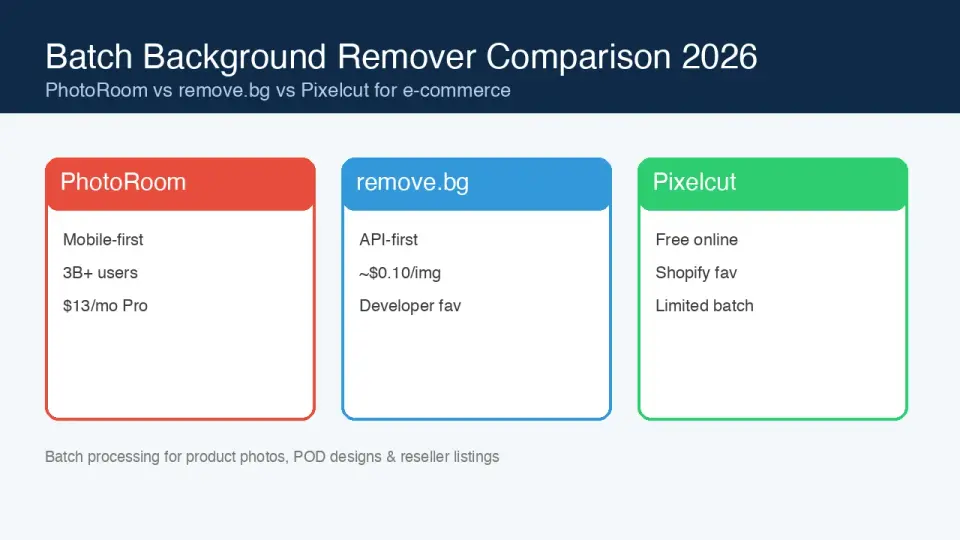
Batch Background Remover Comparison 2026: E-commerce
PhotoRoom, remove.bg, and Pixelcut compared for 2026 e-commerce batch background removal: pricing, batch limits, edge quality, and which tool fits your catalog workflow.
2026-07-28
Which Background Remover Is Most Accurate? Free Tools Compared
Why no background remover is "most accurate", what really decides edge quality, and a five-minute test to rank the free tools on your own photos.
2026-07-26
AI Background Removal: How U2-Net Segments Subjects
How AI background removal works: the U2-Net model, how it predicts a foreground mask, where it succeeds and fails on hair and edges, and how to use and fix its output.